 Swifts
used to nest in the massive trees found in ancient forests.
Nowadays they will sometimes breed in structures like
motorway light gantries, old fortifications and water towers, if they can find a space in
them to make a nest. So why not create a special nest
colony for them on top of a pole or a tower? Swifts
used to nest in the massive trees found in ancient forests.
Nowadays they will sometimes breed in structures like
motorway light gantries, old fortifications and water towers, if they can find a space in
them to make a nest. So why not create a special nest
colony for them on top of a pole or a tower?
| The
Belfast Bus Station Swifts Tower

This
Swift tower was erected in 2012 at the Belfast
Bus Station. It is a commercial model available
ready made from Stoneyford Engineering,
in Lisburn, County Antrim, Northern Ireland.
Photo
© Brian Cahalane
A
good try at a Swift Tower for the London
Olympics 2012

Above,
a design produced for a competition for
a Swift Tower at the London Olympics 2012.
Unfortunately no tower was ever built for
reasons of economy.
Drawing © Paul Goodhall / Hyland Edgar Driver
|
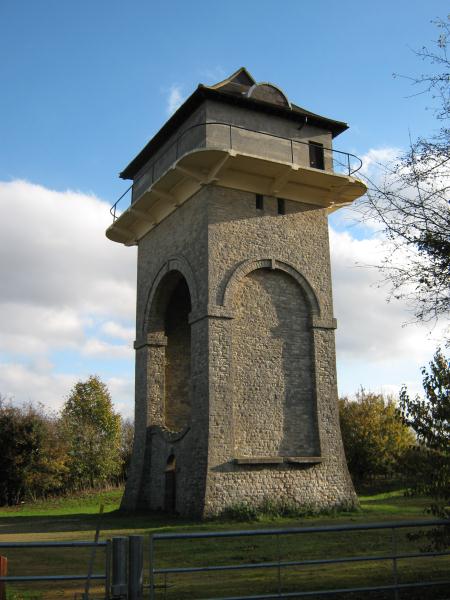
A
good site for a nest box project?
Below,
an
historic water tower near Cherwell in Oxfordshire.
Such a site could be perfect for Swifts,
as commercially available nestboxes might
be fitted easily and fairly unobtrusively
under the balcony.
Photo
© Chris Mason
|
|
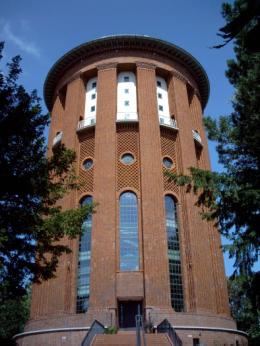
Another
good site for a discreet nestbox project
On the
left, an interesting early 20th Century water
tower in Berlin. This was fitted some years
ago with a good number of Swift nest boxes,
and for some time the colony did well. In
recent years Swifts however have failed
to breed there. No one knows why this is
so, though they are still present in the
sky above the neighbouring apartment blocks.
On
this tower, for architectural and aesthetic
reasons, the nest boxes were bespoke, mounted
internally and made from plywood.
At less
sensitive sites, like modern concrete water
towers, commercial readymade concrete
nest boxes may be used with great ease and
economy.
It is always worth fitting
Swift nest boxes to such sites, as they
have several important advantages; longevity,
security, centralised management, privacy,
peace and quiet, good opportunites for observation
and CCTV/web cam installation, excellent
possibilites for educational activities
involving residents and local schoolchildren
and of course, good publicity for the utility
company involved.
Photo
© Edward Mayer
|
|
|
|
|
On
the banks of the Vistula - Perfect
for Swifts!
This
Swift Tower project was designed by Menthol
Architects in Poland for the Ko[pernicus
Cnetre on the banks fo the Vistula in Warsaw.
Poland's
population of Swifts, once excellent, has
fallen away sharply in recent years, largely
we understand as a result of large-scale
projects to insulate apartment blocks by
cladding them and injecting roof voids
with insulation materials, depriving Swifts
(and bats too) of breeding and roosting
places.
 |
.jpg)
Drawings
© Menthol Architects Warsaw Poland
This tower concept could
go a long way to redress the situation,
were it to be copied in many locations and
were it to be managed sympathetically enough
to provide the Swifts with secure and long-lasting
nestplaces.
|
The
minimum height
for a Tower colony is 7 metres, but the higher
the better, and the safer. The site must not be vulnerable to vandalism. A concentration
of birds may present an attractive target for anti-social
behaviour. Nest places should therefore be sited as
high as possible and at sites which are either unattractive
to vandals or else secure. Industrial estates, electrical
switching yards, MOD sites, nuclear and other power
stations, hospitals, mobile phone masts, railway sidings,
factory towers and chimneys all present good opportunities
for siting tower colonies, while housing
estates, brownfield sites, and unsecured sites in general
should probably be avoided.
N.B. It is essential to have an engineer check the plans
for any proposed Swift Tower for structural
soundness well before any work starts.
 Back to Fitting
Swift Nest Places
Need advice? Consult us! Back to Fitting
Swift Nest Places
Need advice? Consult us!  Back to Contents Back to Contents
|
 Swift
Towers
Swift
Towers