Swift First Aid & Care
You
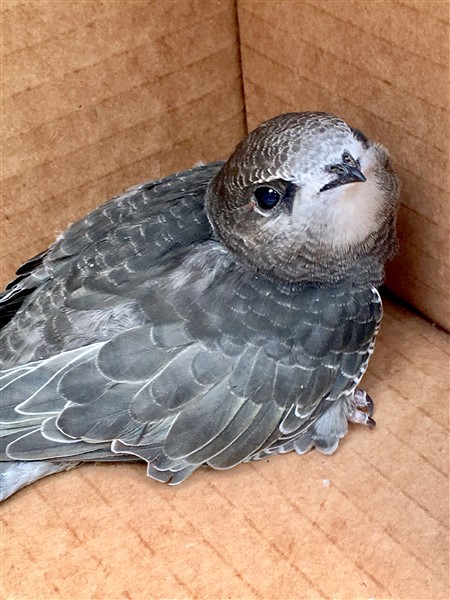
have found a fallen Swift 1. Put your Swift in a quiet, warm, safe, calm & clean environment - a ventilated shoe box is ideal and put it somewhere away from any disturbance. See photo on the right - the Swift is calm 2. Take a photo and if you can, weigh the bird too - you can assess its age using the photos below 3. Give it water by running a wetted cotton bud around the edge of the beak avoiding the nostrils 4. Measure the Swift's wing length (see photo below). It can only fly if its wings are each at least 16cm long 5. Don't try and care for the Swift yourself. It is high-risk, difficult, expensive & time-consuming 6. Contact a Carer from the list below; give them information about your Swift; get the Swift to them ASAP  The
distance to measure is the red line on the photo (left)
The
distance to measure is the red line on the photo (left)
Call a UK Swift
Carer - providing advice,
treatment and care NB: These are all independent care providers. Where we can we check on their abilities and procedures, but unfortunately this is not always possible. If you are not happy with any care provider's response please select another. If you find a carer's services unacceptable, please inform the RSPCA. They are the only body in England with the legal right and duty to inspect animal care premises. In Scotland carers handling more than a minimal amount of wildlife need to be Licenced and a copy of the Licence must be on display where the public can see it, including on web sites. We only list Licenced Carers in Scotland. E-mail and Internet web page links are underlined  Cheshire -
RSPCA Stapeley Grange Wildlife Centre,
London Road, Nantwich CW5 7JW Open 08:00 to 20:00
(21:00 May to Sept) Call 0300 1230722 Cornwall (North) - Michelle Clement - Call 07508532811 or use WhatsApp Cumbria - Kendal College Animal Rescue Milnthorpe Road, Kendal LA9 5AY telephone 01539 814700 Monday to Friday only Derbyshire - Pet Samaritans - St Bernard's Animal Sanctuary & Wildlife Rescue Centre, Chesterfield S41 9EA - call 01246 455777 / 07872421878 Devon (edge of Somerset) North Combe, Shillingford, Tiverton - L Goss - Call 07732 943781 Essex (Basildon) - Nature's 2nd Chance Wildlife Rescue click here to e-mail Essex (East) Transport Only - Wildlife Ambulance - 24 hour Rescue Hotline - Call 03001 026999 Essex (Maldon) Wildlife Rescue, 30 Cross Road Maldon, CM9 5EE - Call 07811 307162 Essex (South) South Essex Wildlife Hospital - Call 01375 893893 Hampshire - Hart Wildlife Rescue Unit 9 Lower Soldridge Business Park, Soldridge Road, Medstead, Alton GU34 5JF
Hampshire - Wildlife
Rescue
- Ringwood - Please phone 01425 477500 /
07765 327558
Hertfordshire and Buckinghamshire - Clare Nuttall - Please phone 07917877333 or e-mail here Hertfordshire - Wildlife Welfare - Please phone 01438 313526
Isle of Wight Bird Rescue - Please phone 07939 103398 or 07505 200160 or e-mail iowbirdrescue@gmail.com Kent - Folly Wildlife Rescue, Broadwater Forest Wildlife Hospital, Fairview Lane, Broadwater Forest, Tunbridge Wells, TN3 9LU telephone 01892 543 213 Lancashire (South) - Bolton & Bury Swifts - please Call/Text/WhatsApp 0755 7796508 Lincolnshire (South) M Sutherland - Click the link to e-mail
/ 'phone 07947 664811 London Wildlife Protection - 07909 795064 If you find a sick or injured bird call the Emergency helpline between 9am and Midnight London - Claire Nuttall Call - 07917 877333 Click here to e-mail Manchester (Greater) - Bolton & Bury Swifts - please Call/Text/WhatsApp 0755 7796508 Norfolk/Suffolk/Cambs border - Claire Scarff - Texts, calls, WhatsApp to 0777 3226963 North Shropshire Summer Wings Rescue 07508 332241 (please text or leave a message if no answer) Nottingham & Derby - Feline & Wildlife Rescue - Click the link to go to their website and make contact (also on Facebook) Nottinghamshire - Newark - Jane's wild Bird Rescue - Use 0789 2682067 to send a text or Facebook Jane's Wildbird Rescue Newark Oxfordshire Wildlife Rescue, Woodway Road, Blewbury, Oxfordshire, OX11 9HW - Call 07549
322464 Scotland - Aberdeenshire - New Arc Wildlife Rescue, Nether Auquhadlie, Auchnagatt, Ellon AB41 8UW - Click the link to e-mail or call 01358701723 Scotland (Highlands) - Highland Wildlife Rescue at 146 Ladies Loch, Brora KW9 6NG Call 07957 584817 Somerset - RSPCA West Hatch Wildlife Hospital - Taunton TA3 5RT Open 0800 to 2100 Call 0300 123 0721
Somerset - Secret World Wildlife Rescue, New Road Farm, New Road, East
Huntspill, Highbridge,TA 3PZ Telephone 01278 783250 Surrey - Helena Finden-Browne - Call 01483 767209 or 07977 911985 Surrey
Wildlife Aid Foundation - Randalls Farmhouse, Randalls Road, Leatherhead KT22 0AL Hours: daily 9am – 8pm
- Click the link for details Sussex (East) Seahaven Wildlife Rescue, 14 Merewood Court, 60 Carew Road, Eastbourne BN21 23R - Call 03005 610608 Sussex (East) WRAS Wildlife Rescue, 8 The Shaw Barn, Whitesmith, Lewes, East Sussex BN8 6JD telephone 0300 1026 999 Sussex (West) A Ingram, (Horsham) please e-mail or call 0791 9090194
Sussex (East) Wildlife A & E, Unity Cottage, High Cross, Rotherfield, Crowborough TN6 3PX telephone 0770 957 4665 e-mail - click here
Wiltshire
Wildlife Hospital, New Farm, 1 Amesbury Road, Newton Tony, Nr.
Salisbury, Wiltshire SP4 0HW Call - 0785 0778752 (24 hours) Wiltshire and all areas around Swindon, Teresa & Andy Farr- Call 0788 690 0568 or 0745 570 5755 Yorkshire (North) Wildlife Haven, Thirsk Call 0777 287 1833 www.facebook.com/thewildlifehaven Yorkshire - Leeds Swifts 07778 768719 leedsswifts@gmail.com Yorkshire (West)
B
Thorne
- Ilkley - Can transport birds to local
carers - Click the link to e-mail
/ 'phone 01943 816488 Transport of injured and sick wildlife (a nation-wide service) UK Wildlife Transporters - click on the link Cheshire -
RSPCA Stapeley Grange Wildlife Centre,
London Road, Nantwich CW5 7JW Open 08:00 to 20:00
(21:00 May to Sept) Call 0300 1230722 Cornwall (North) - Michelle Clement - Call 07508532811 or use WhatsApp Cumbria - Kendal College Animal Rescue Milnthorpe Road, Kendal LA9 5AY telephone 01539 814700 Monday to Friday only Derbyshire - Pet Samaritans - St Bernard's Animal Sanctuary & Wildlife Rescue Centre, Chesterfield S41 9EA - call 01246 455777 / 07872421878 Devon (edge of Somerset) North Combe, Shillingford, Tiverton - L Goss - Call 07732 943781 Essex (Basildon) - Nature's 2nd Chance Wildlife Rescue click here to e-mail Essex (East) Transport Only - Wildlife Ambulance - 24 hour Rescue Hotline - Call 03001 026999 Essex (Maldon) Wildlife Rescue, 30 Cross Road Maldon, CM9 5EE - Call 07811 307162 Essex (South) South Essex Wildlife Hospital - Call 01375 893893 Hampshire - Hart Wildlife Rescue Unit 9 Lower Soldridge Business Park, Soldridge Road, Medstead, Alton GU34 5JF
Hampshire - Wildlife
Rescue
- Ringwood - Please phone 01425 477500 /
07765 327558
Hertfordshire and Buckinghamshire - Clare Nuttall - Please phone 07917877333 or e-mail here Hertfordshire - Wildlife Welfare - Please phone 01438 313526
Isle of Wight Bird Rescue - Please phone 07939 103398 or 07505 200160 or e-mail iowbirdrescue@gmail.com Kent - Folly Wildlife Rescue, Broadwater Forest Wildlife Hospital, Fairview Lane, Broadwater Forest, Tunbridge Wells, TN3 9LU telephone 01892 543 213 Lancashire (South) - Bolton & Bury Swifts - please Call/Text/WhatsApp 0755 7796508 Lincolnshire (South) M Sutherland - Click the link to e-mail
/ 'phone 07947 664811 London Wildlife Protection - 07909 795064 If you find a sick or injured bird call the Emergency helpline between 9am and Midnight London - Claire Nuttall Call - 07917 877333 Click here to e-mail Manchester (Greater) - Bolton & Bury Swifts - please Call/Text/WhatsApp 0755 7796508 Norfolk/Suffolk/Cambs border - Claire Scarff - Texts, calls, WhatsApp to 0777 3226963 North Shropshire Summer Wings Rescue 07508 332241 (please text or leave a message if no answer) Nottingham & Derby - Feline & Wildlife Rescue - Click the link to go to their website and make contact (also on Facebook) Nottinghamshire - Newark - Jane's wild Bird Rescue - Use 0789 2682067 to send a text or Facebook Jane's Wildbird Rescue Newark Oxfordshire Wildlife Rescue, Woodway Road, Blewbury, Oxfordshire, OX11 9HW - Call 07549
322464 Scotland - Aberdeenshire - New Arc Wildlife Rescue, Nether Auquhadlie, Auchnagatt, Ellon AB41 8UW - Click the link to e-mail or call 01358701723 Scotland (Highlands) - Highland Wildlife Rescue at 146 Ladies Loch, Brora KW9 6NG Call 07957 584817 Somerset - RSPCA West Hatch Wildlife Hospital - Taunton TA3 5RT Open 0800 to 2100 Call 0300 123 0721
Somerset - Secret World Wildlife Rescue, New Road Farm, New Road, East
Huntspill, Highbridge,TA 3PZ Telephone 01278 783250 Surrey - Helena Finden-Browne - Call 01483 767209 or 07977 911985 Surrey
Wildlife Aid Foundation - Randalls Farmhouse, Randalls Road, Leatherhead KT22 0AL Hours: daily 9am – 8pm
- Click the link for details Sussex (East) Seahaven Wildlife Rescue, 14 Merewood Court, 60 Carew Road, Eastbourne BN21 23R - Call 03005 610608 Sussex (East) WRAS Wildlife Rescue, 8 The Shaw Barn, Whitesmith, Lewes, East Sussex BN8 6JD telephone 0300 1026 999 Sussex (West) A Ingram, (Horsham) please e-mail or call 0791 9090194
Sussex (East) Wildlife A & E, Unity Cottage, High Cross, Rotherfield, Crowborough TN6 3PX telephone 0770 957 4665 e-mail - click here
Wiltshire
Wildlife Hospital, New Farm, 1 Amesbury Road, Newton Tony, Nr.
Salisbury, Wiltshire SP4 0HW Call - 0785 0778752 (24 hours) Wiltshire and all areas around Swindon, Teresa & Andy Farr- Call 0788 690 0568 or 0745 570 5755 Yorkshire (North) Wildlife Haven, Thirsk Call 0777 287 1833 www.facebook.com/thewildlifehaven Yorkshire - Leeds Swifts 07778 768719 leedsswifts@gmail.com Yorkshire (West)
B
Thorne
- Ilkley - Can transport birds to local
carers - Click the link to e-mail
/ 'phone 01943 816488 Transport of injured and sick wildlife (a nation-wide service) UK Wildlife Transporters - click on the link Ask your Vet or the RSPCA -
they may be able to help, they may know of local
wildlife carers who provide advice & treatment & care - click on the underlined text to see their website or make contact
 Lynda
Huxley
(Eire) Lynda
Huxley
(Eire) Refuge de L'Arche de Noe
Saint-Joseph des Genêts, 53200
Château-Gontier, Mayenne, France 0033 2 43 07 24 38 Les Martinets d'Azur Nice, Provence, France Les Remiges Noires Chennevières-sur-Marne, France e-mail: lesremigesnoires@gmail.com Le Réseau des Centres de Soins de la Faune en France
Refuge de L'Arche de Noe
Saint-Joseph des Genêts, 53200
Château-Gontier, Mayenne, France 0033 2 43 07 24 38 Les Martinets d'Azur Nice, Provence, France Les Remiges Noires Chennevières-sur-Marne, France e-mail: lesremigesnoires@gmail.com Le Réseau des Centres de Soins de la Faune en France Friends of the Swifts Sde Boker 39 Givatayim 5346559, Israel 0505-460371 Friends of the Swifts Sde Boker 39 Givatayim 5346559, Israel 0505-460371 Italy - LIPU's Guide to Wilfdlife Care Facilities - I Centri recupero in Italia
Liberi di Volare 2012
(Strada di Fiume, n.527 Trieste, Italy) Oriana
Ferrandino (Regione di Abruzzo) Italy - LIPU's Guide to Wilfdlife Care Facilities - I Centri recupero in Italia
Liberi di Volare 2012
(Strada di Fiume, n.527 Trieste, Italy) Oriana
Ferrandino (Regione di Abruzzo) Hilde
Matthes
(Frankfurt am Main)
Hilde
Matthes
(Frankfurt am Main) Enric
Fuste
(Catalunya)
Enric
Fuste
(Catalunya) Andalusia
/ Andaluza Centros de Recuperatión de Especias Amenazadas
Andalusia
/ Andaluza Centros de Recuperatión de Especias AmenazadasAlmería CREA La Almohallas 670 94 45 92 Cádiz CREA Dunas de San Antón 670 94 61 98 Córdoba CREA Los Villares 670 94 79 01 Granada CREA El Blanqueo 670 94 56 99 Jaén CREA Quiebrajano 670 94 62 63 Málaga CREA Pecho Venus 670 94 45 98 Sevilla CREA San Jerónimo 670 94 15 92  Extremadura
Provincia de Badajoz - AMUS (Acción por el Mundo Salvaje) 924 12 40 51 Provincia de Cáceres - Centro de Recuperación de Fauna "Los Hornos" 927 20 01 70  Poland - Wiecej informacji na temat jerzyka, kwestii zwiazanych z jego gniazdowaniem oraz
innych wskazowek mozna uzyskac na
Poland - Wiecej informacji na temat jerzyka, kwestii zwiazanych z jego gniazdowaniem oraz
innych wskazowek mozna uzyskac na stronie Fundacji Ratujmy Ptaki e-mail: Warszawa , e-mail Szczecin For the General Directorate for Environmental Protection's List of animal rehabilitation centres: Click HERE  Portugal - CRAS - Centro de Recuperação de Animais de Lisboa, Parque
Florestal de Monsanto - REstrada das Perdizes, 1599 068 Lisboa
Portugal - CRAS - Centro de Recuperação de Animais de Lisboa, Parque
Florestal de Monsanto - REstrada das Perdizes, 1599 068 Lisboatelephone: +351 2181 70200 nor +351 2181 70201 e-mail: lxras@cm-lisboa.pt  Johannesburg - South Africa - Friends of Free Wildlife website, telephone 082 701 8318 and e-mail Johannesburg - South Africa - Friends of Free Wildlife website, telephone 082 701 8318 and e-mail Gökçe Coşkun - wildlife rehabilitation (Turkey) & in Ankara please contact SKYD by phone +90 553 952 08 07 and e-mail
  Switzerland - Zurich Canton Switzerland - Jura-Vaud La Vaux-Lierre Chemin de la Vaux 17 1163 Etoy
+41218087495 info@vaux-lierre.ch Switzerland - Zurich Canton Switzerland - Jura-Vaud La Vaux-Lierre Chemin de la Vaux 17 1163 Etoy
+41218087495 info@vaux-lierre.ch Essential information websites for Vets & licensed wildlife rehabilitators Falciot Negre  Deutsche Gesellschaft fűr Mauersegler e.v. Deutsche Gesellschaft fűr Mauersegler e.v. Both sites are managed by qualified Veterinarians specialising in Swift care and have English language texts
|
|||||||||
|
|